International Dimensions of the Environmental Crisis by Richard N Barrett
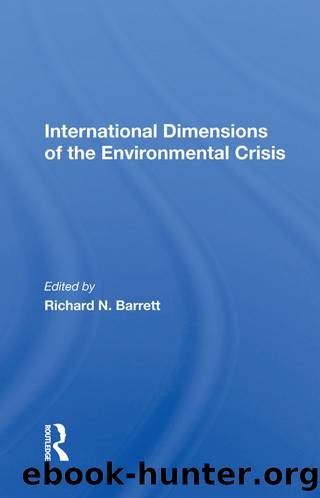
Author:Richard N Barrett [Barrett, Richard N]
Language: eng
Format: epub
Tags: Political Science, General
ISBN: 9780429716188
Google: TkxDEAAAQBAJ
Goodreads: 58985264
Publisher: Routledge
Published: 2021-11-28T00:00:00+00:00
NATO
None of the other European regional organizations possess quite the institutional muscle of the European Communities, but that fact has hardly slackened at least their formal attention to environmental matters. The North Atlantic Treaty Organization (NATO) has attracted critical scrutiny and sparked controversy by its organizational entry into the environmental field in 1969.6
President Richard Nixon proposed on April 10, 1969, that NATO "explore ways in which the experience and resources of the Western nations could most effectively be marshalled toward the quality of life of our peoples" (Remarks, 1969:5). He also noted that "the industrial nations share no challenge more urgent than that of bringing 20th century man and his environment to terms with one anotherâof making the world fit for man, and helping man learn how to remain in harmony with his rapidly changing world" (Remarks, 1969:7).
The Nixon initiative resulted in the creation by the NATO Foreign Ministers of the Committee on the Challenges of Modem Society (CCMS), which is responsible for examining ways to improve the environment of NATO states. NATO's environmental role has been called its "Third Dimension," adding to the alliance's military and political functions (Huntley, 1971:6-7). Article 2 of the North Atlantic Treaty, however, already gives the alliance a broad mandate for civil cooperation:
The Parties will contribute toward the further development of peaceful and friendly international relations by strengthening their free institutions, by bringing about a better understanding of the principles upon which these institutions are founded, and by promoting conditions of stability and well-being. They will seek to eliminate conflict in their international economic policies and will encourage economic collaboration between any or all of them.
The North Atlantic Council, NATO'S governing body, created a Committee of Three on Non-Military Cooperation in May of 1956. The recommendations of that Committee resulted in the creation of a number of specialized committees and the undertaking of new programs in cultural, economic, scientific and other areas of "non-military" cooperation. NATO'S environmental "Third Dimension" would seem to be a natural extension of this kind of activity.
CCMS is charged to pay due regard to the aims of the NATO alliance and is not to undertake executive action or engage in research itself. Rather, its concern is to stimulate action by member states via two basic concepts. First is the idea of the pilot country. which involves a country (possibly in association with others) taking responsibility for the study of a particular environmental problem. The pilot country plans, pays for, reports on, and tries to implement the results of its study. Second, it is hoped these efforts will result in the formulation of government policy and legislation. This hope rests in large measure on the fact that a NATO pilot country has put its prestige and resources on the line before its allies in seeking a solution to an environmental problem of presumably both national and international interest and relevance. To date there have been pilot studies in such areas as coastal water and air pollution, disposal of hazardous substances, transportation
Download
This site does not store any files on its server. We only index and link to content provided by other sites. Please contact the content providers to delete copyright contents if any and email us, we'll remove relevant links or contents immediately.
| Anthropology | Archaeology |
| Philosophy | Politics & Government |
| Social Sciences | Sociology |
| Women's Studies |
The Secret History by Donna Tartt(19088)
The Social Justice Warrior Handbook by Lisa De Pasquale(12190)
Thirteen Reasons Why by Jay Asher(8909)
This Is How You Lose Her by Junot Diaz(6886)
Weapons of Math Destruction by Cathy O'Neil(6279)
Zero to One by Peter Thiel(5801)
Beartown by Fredrik Backman(5754)
The Myth of the Strong Leader by Archie Brown(5507)
The Fire Next Time by James Baldwin(5444)
How Democracies Die by Steven Levitsky & Daniel Ziblatt(5218)
Promise Me, Dad by Joe Biden(5153)
Stone's Rules by Roger Stone(5087)
A Higher Loyalty: Truth, Lies, and Leadership by James Comey(4962)
100 Deadly Skills by Clint Emerson(4925)
Rise and Kill First by Ronen Bergman(4788)
Secrecy World by Jake Bernstein(4753)
The David Icke Guide to the Global Conspiracy (and how to end it) by David Icke(4717)
The Farm by Tom Rob Smith(4507)
The Doomsday Machine by Daniel Ellsberg(4490)
